
Nicosia’s Ledra Street was once the longest pedestrianised street in Europe, buzzing with the sights and sounds of commerce; traditional pleated skirts or vrakas would flutter behind processions of Greek Cypriots off to barter for the multicoloured produce painting the street’s margins or for animals milling around awaiting their fate. Such a bustle and cacophony could scarcely be contained even by the mighty fortified walls that the Venetians had built in the shape of a snowflake to protect the entire old town. In marked contrast, decades later, my stroll came to an abrupt and premature end at a checkpoint, part of the so-called Green Line that now slices that fortified snowflake in half.
Not only has its longest accolade gone, but so too has Ledra lost its animals and street traders. In their place, I found Starbucks, McDonalds and H&M just like any other main street in Europe. However, on approaching that checkpoint, I soon realised that this is no ordinary street. Nowhere else in Europe must you show your passport to continue a shopping expedition. Or run the risk of getting stuck on the wrong side, separated from your luggage, bed and even family members perhaps. While divided Berlin endures in the collective consciousness as a poignant symbol of the Cold War, Nicosia’s partition endures in fact, with no end in sight. Since I had left my passport at my hotel and the sun was pounding me into a sweaty pulp, I retreated back up Ledra to the nearest shady street bar.
There I refreshed myself as the call to prayer echoed across the Green Line from the Turkish side while a Greek Cypriot on a balcony above me spoon-fed her baby. A steady stream of people were crossing the border in both directions, day packs and tourist garb suggesting brief voyages of curiosity rather than a serious attempt to bridge the gulf between both sides. For where else in Europe can a few strides and a flash of a passport bring such profound cultural and religious transformation?
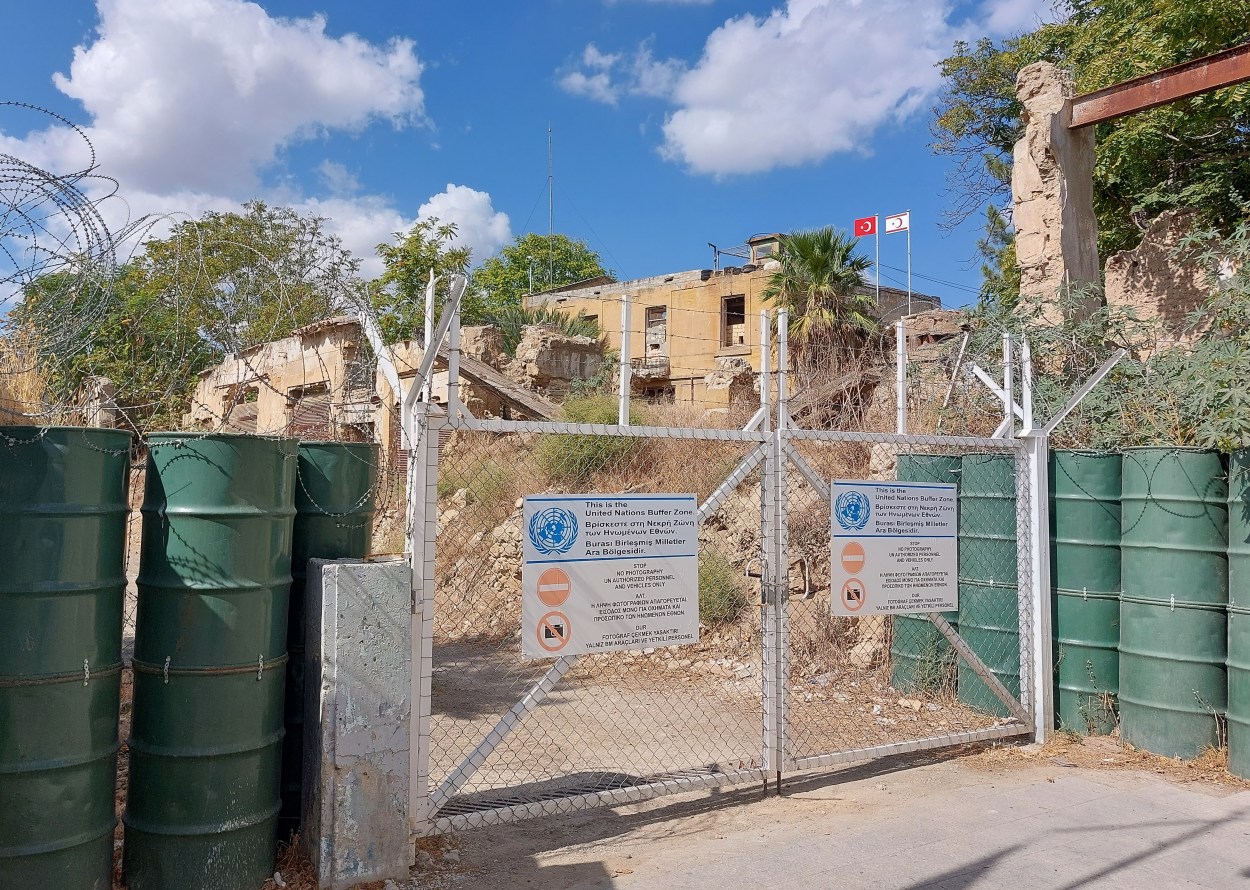
Energies regained, I sought to follow the Green Line across Old Nicosia from one side of the snowflake to the other. That was easier said than done as Ledra is not the only street partitioned. Sometimes, my way was barred by a sentry post where a soldier waved his gun in warning before I could focus my camera on him; other times physical barriers frustrated me: walls of concrete topped with barbed wire or oil drums sprouting tropical plants and emblazoned with the ironic graffiti “migrants welcome”.
Scrambling up the crumbling stairs of one ruin, I looked across the wasteland of other ruins – a no man’s land preserving war damage at the point where the Turkish advance ground to a halt and which has served ever since as a buffer zone between Turkish and Greek Cypriots under the watchful eyes of UN peacekeepers – to see the distinctive crescent and star of the Turkish flag flapping above sentry posts and etched into the side of a distant mountain, leaving observers like me in no doubt as to the status quo whatever the international community might say (only Turkey officially recognises Northern Cyprus).
Though the origins of this dispute are complex and stretch back to British rule and beyond, the partition itself dates from 1974 when Turkey invaded the north in response to a Greek military coup that aimed to unite the island with mainland Greece. Since then, the northern third has been run by a Turkish Cypriot government and the southern two-thirds by the internationally-recognised Greek Cypriot government while the UN patrols the buffer zone in-between and seeks to progress reunification talks, mostly in vain.
So, forty years after the invasion, there is still little hope of the snowflake regaining its integrity or of Ledra reclaiming its title as Europe’s longest pedestrianised street. As for me, nearing the snowflake, my progress was halted one last time. Here the Green Line was patrolled not by a soldier but by a mangy ginger tomcat, and, weaving gracefully and fearlessly between strands of barbed wire, he appeared to be a seasoned sentinel here. My own curious, zigzagging stroll across divided Nicosia had been a rare chance to see one of history’s great dramas frozen in time; I was left in no doubt that political sensitivities were undiminished and that it would be unwise to defy the warnings to careless travellers festooned all along the Green Line. Just as I had swiftly hidden my phone when the soldier brandished his weapon, so too now I refrained from testing the resolve of that tomcat.

