
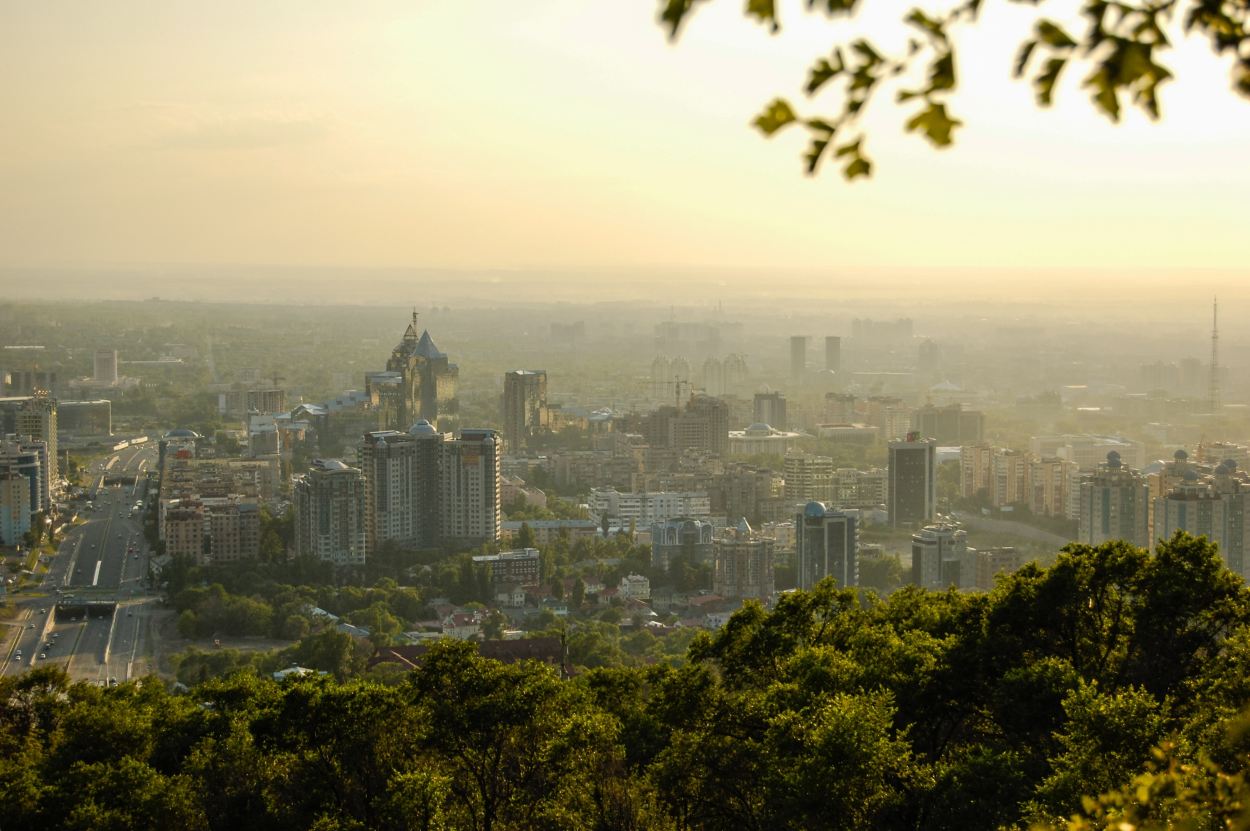
Almaty is one of the greenest cities I’ve seen, and I mean green in the old-fashioned not the eco-friendly sense. The architecture is more functional than aesthetically pleasing: modernist Soviet structures with all the finesse of giant concrete Lego blocks host public and residential life while glass towers built on petrodollars house capitalist enterprises that would make Kazakhstan’s former Soviet masters turn in their graves. But who cares about architectural follies when those buildings are enveloped in foliage and look out onto the snow peaks of the Tien Shan mountain range?
Elsewhere, the Soviets might have sacrificed everyday comfort and beauty to meet their revolutionary ends, but Almaty almost seems deliberately planned to compensate citizens for everyday privations by putting nature on their doorsteps. Walking down any avenue they will be flanked by trees, particularly striking when splashed with autumn shades of green, red and yellow, and they will soon stumble across lush green parkland ornamented with flowers. And the rainbows forming in fountains on sunny days are simply sublime.
Republic Square was perhaps designed to overawe the local proletariat and emphasise the collective power of the Soviet Union but, instead, it is the Tien Shan mountains that dominate the skyline, overshadowing the huge city hall and even the independence column that is topped with the iconic bronze statue of the “golden man” on a winged leopard (in homage to the ancient Scythian noble found buried in a golden suit of armour with a hoard of gold). Originating in the Paleozoic era when continental blocks collided, these mountains long predate our political systems, ancient civilisations and even the human species itself, reminding us of our insignificance more than our achievements.
For the more adventurous keen to escape the imprint that humankind has since left, mountain lakes and hiking trails are easily accessible too. Right from downtown Almaty, a gondola whisks you up to the summit of Kok Tobe for sweeping city and mountain views. Alternatively, a short bus ride takes you to Medeu, where in winter you can skate on the world’s highest ice rink while snow-dusted fir trees whizz past, or else take a cable car up to the Shymbulak ski resort. The hike to Big Almaty Lake is another popular trip; the trailhead can also be reached by car, though the road was closed when I was there due to the icy conditions or to protests, depending on who you believed. Luckily, I could easily divert to Issyk Lake, which, on that sunny day with snowy peaks and autumn leaves reflecting in azure waters, was as beautiful as any alpine lake I had seen.
But what of Almaty’s green credentials in the other sense? These might easily be disregarded considering that Kazakhstan is Central Asia’s largest oil producer and a major producer of natural gas, epitomised by the SUVs that power around the city spewing out contamination, but change is afoot. Both the official airport website and the huge airport taxi sign opposite the arrivals area promised me an electric car journey into town, although, in practice, I was met not with the gentle hum of battery power but rather the familiar chug of the combustion engine. Like many cities nowadays, Almaty has a public electric scooter rental scheme; in my opinion, these will remain a menace, particularly to the elderly, unless some kind of highway code is introduced, but I cannot deny their green credentials all the same.
According to the Kazakh Ministry of Energy, as of 2022, 130 renewable energy facilities had been installed across the country with a total capacity of 2,400 megawatts, including 46 wind farms, 44 solar power plants, 37 hydroelectric power plants and three biomass power plants. This forms part of Kazakhstan’s ambition to generate 50 per cent of its electricity from renewable sources by 2050, backed by an auction system for funding renewable projects and a new green bonds market. All this might seem relatively modest given the scale of climate change and the country’s landmass (the ninth largest nation on earth). However, even if one suspects that greening derives from a desire to improve Kazakhstan’s image in the eyes of the world, a charge levelled at other oil producers like recent COP 28 hosts the UAE, any change is nevertheless to be welcomed.
Whatever the reality of Kazakhstan’s climate and energy policy, all those Almaty trees are surely doing their bit too. There is no commonly accepted average for car emissions or for carbon capture by trees, but, for the sake of argument, let us randomly follow one “Internet scientist” in saying that the typical car emits 130 grams of CO2 per kilometre and the average tree absorbs about 30 kilograms of CO2 per year (1). In that case, by my calculations, one tree would offset 230 kilometres of car travel per year. In the case of Almaty, this should be doable as long as that car remains within the city boundaries! Luckily, there is plenty of diversion nearby, green or otherwise.
Postscript. As an aside, my own green contribution in Kazakhstan consisted of eating horse meat (served with thick, flat noodles and onion sauce as part of the national dish, beshbarmak). Counter-intuitive I know, but please bear with me. Once again, randomly following the calculation of one “expert” (on the Horse and Country TV Channel’s web page) a horse should typically eat about two and a half per cent of their body weight in grass or hay every day, which means that the average 450 kilogram adult horse will consume around eleven kilograms daily(2). By my calculations, that is a whopping 4,015 kilograms of innocent grass per year that I saved at one restaurant sitting!
(1) https://www.ethicalreading.org.uk/how-many-trees-to-offset-a-car-commute/
(2) https://horseandcountry.tv/what-do-horses-eat
Photo credit: Alexander Serzhantov on Unsplash.
 Nomad Scribe